Money is a lot like gasoline. In a gas tank, it can get a loved one to hospital and save a life. In a leaky container in a basement, it’s a time-bomb. Money is neither good nor bad; money is volatile potential energy. We can’t live without it, and, despite its necessity, it remains a hazardous material. The cherry on top, of course, is that everyone believes if they just had more money, they would be well and happy. There is very little understanding of the ironies of fortune. As Jimi Hendrix said, “A rich man can sing a whole lotta blues.”
Since the mid to late 00s, I have been working with high-functioning, high-value families. In this time I have come to recognize patterns that repeat regarding wealth and the launch stage of childrearing. The people are all different, but the woes are, by contrast, remarkably uniform. For ease of navigation, this piece is in three sections:
Incidental Learning and Character Formation
Two Types of Narrative Obstacle
Parenthood’s Missing Second Act
These are the markers for the trek ahead. You can skip to where you’d like and then be roundly compelled to read what you haven’t, or simply follow the trail. The patterns I’m relating correspond to a consistent arc of suffering in the dominant culture, particularly where there is deep material security. When made conscious, these dynamics have the power to point us towards a balance that has been lost.
Incidental Learning and Character Formation
The principal problem that affluence brings is the ability to alter consequences. Choices produce consequences. Our conscious and unconscious take-aways from this progression inform what becomes habit. In time, habits crystallize into character. Money can interrupt the natural iterative process of feedback and alters the non-academic, incidental learning drawn from how life is experienced. Money can buy alternative results despite our choices. Sometimes, muting or removing consequences leaves certain behaviors unchecked or even incentivized.
Consequence Buy-outs
An under-age teen is spared due criminal penalty because parents are connected and monied. The teen is disciplined at home and earlier anger issues increase, carrying outside of family. Over the next nine years, parents bail out their young adult for various conflicts with peers, legal binds, and relationship complications. At age 25, the adult is asked to leave a Ph.D. program, a consequence the parents cannot mitigate. Then, treatment begins.
The learning had become, “I can displace upon the world with impunity.” The original wound was eventually revealed to be marital infidelity by one parent, implicitly understood but never named. The parents may have been initially motivated by guilt, unspoken understanding, and their kid’s initial immaturity. Additionally, families in the public-eye feel compelled to keep things in-house until it cannot be contained. When the music finally stopped, nine years of critical personality and life-stage development had been shaped by shielding the kid from the consequences of their actions.
Truth Diversions
Alternatively, with resources to stave off natural consequences, critical truths can remain obscured:
A teen’s academic struggles are over-scaffolded through private tutors. As a result, the student gains entry to a university they are overwhelmed by. The over-scaffolding continues. The student’s sense of competence, autonomy, and authenticity is degraded resulting in failure to launch, shame, depression, anxiety masquerading as a THC problem by age 24.
The learning became, “I am an imposter,” as a substitute for an earlier, “I need a school and a path that fits me better.” The teen may have sincerely wished to fulfill a family university legacy. The family identity wanted to make sure this could happen. From the outside, it looked like buying a narrative. From the inside, it was about misunderstanding what confers belonging.
But wouldn’t you do anything for your kid? “No” is a word that we and they have to identify with. We need to learn the value of “no” as children, as teens, as adults, and as parents. If we only give them what they want, we are metaphorically letting them eat ice cream three times a day.. Loving them includes being prepared for them to hate our guts in service to them fledgeing, understanding functional limits, becoming responsible for their choices. The alternative is letting them or making them devotees of power who leverage acquiescence from the world instead of earning what they need through relationship. This is the opposite of meaningful connection to others. Anti-social Personality and, by contrast, Borderline Personality are different ways of falling for various types of power instead of achieving the ability to “relationship.”
Two Types of Narrative Obstacle
The “Self-made” Parent
Self-made parents are often larger than life to their kids. Their success precludes their kids being self-made, a categorical division within the family. The parent and the child often have very different perceptions of the family’s material security. The parent had a long story that started with being “one of the people.” The rest was pluck, luck, hard work, and will. That journey reinforced confidence and certainty of self. Likely, they are still very much “of the people,” and their identity is a diversity of life and class experiences. The material security is, to them, like an oasis they built through their own agency. However, for their children, the material security can be like a nest high on a mountain top. On every side the drop is sheer. They must fly or perish. There was no journey up the mountain. They did not come from among the people. Their life and class experiences are homogenous. Many decide not to truly leave the nest. Many parents let them stay dependent forever. The cars, houses, trips, education, trusts, estates, and percentages in family businesses easily become ersatz umbilical cords that stunt adulthood. They can remain, despite all affectations to the contrary, a child.
A subtle continuation of this paradigm can happen over a couple of generations where there is real family warmth. When a first generation experiences great trauma and a successive generation generates great wealth, a certain pattern can emerge. I encounter a common block in these latter parents toward the corrective necessities of parenting. It is as if all the ancient trauma (which is heritable) is contained by only dealing in proverbial carrots and never proverbial sticks. These parents have insufficient permission to challenge, thwart, or curb their own kids. There are many children with the temperament to do well, regardless, but, invariably, there are those of us who need more than sugar to develop past ego-centrism. This context can produce grandiose and covert types of narcissism.
The “Lonely Child” Parent
These parents may have grown up in great financial stability that acted as a substitute for relationship, or they may not have had financial stability either. As adults, they don’t necessarily present as needy. Often, in childhood, they promised that they would give their kids what they never had themselves. With sizable wealth, these vectors are given particular power. These are parents ready to nurture but they nurture from their lonely/scared inner-Child, not from their inner-Parent (Transactional Analysis: Berne) (1). This set-up is not a perpetual block. Its trouble is that it often goes unidentified.
In the early years, when children need to be minded and taught, these parents are often rock stars. The difficulty comes when the kids need them increasingly out of the way. They insufficiently facilitate the kids’ struggle, fail, revolt, change to be more than their kid (Individuate). In adolescence their kids’ natural development subtly runs counter to their own unmet inner-Child’s needs. “Parent” is revealed to be too much of an identity (who I am) and not enough of a role (what I do). This limits room in the relationship for the kid to healthfully separate and the other human, who has been parenting, to evolve. The kids often stay enmeshed, rebel, or both.
Money tends to camouflage these deeper truths. The abundance of provision and consideration, the parent’s sophisticated, platonic seductiveness can make young adults misidentify their natural urge for space as ingratitude, selfishness, and unkindness. Young adults may end up offering various forms of dependency as an unconscious tribute to a parent who, ironically, never wanted anything other than the best for them. The perception of failure reenacts the original wound in the parent.
Life can have a dark sense of humor: sometimes a kid gets one of each; sometimes a self-made parent was also a lonely child.
Parenting’s Missing Second Act
Nature’s purpose of parenting is to raise children to have the emotional, practical, and, in today’s world, vocational ability to adequately raise a next generation. It is a job, for each generation, of working towards its own redundancy: “I will have done my job well when I know you don’t need me anymore.” However, this is taken to be the whole task when, actually, birth through launch is only the first half. We may be avoiding having our kids fledge because there is no sense of our purpose afterwards.
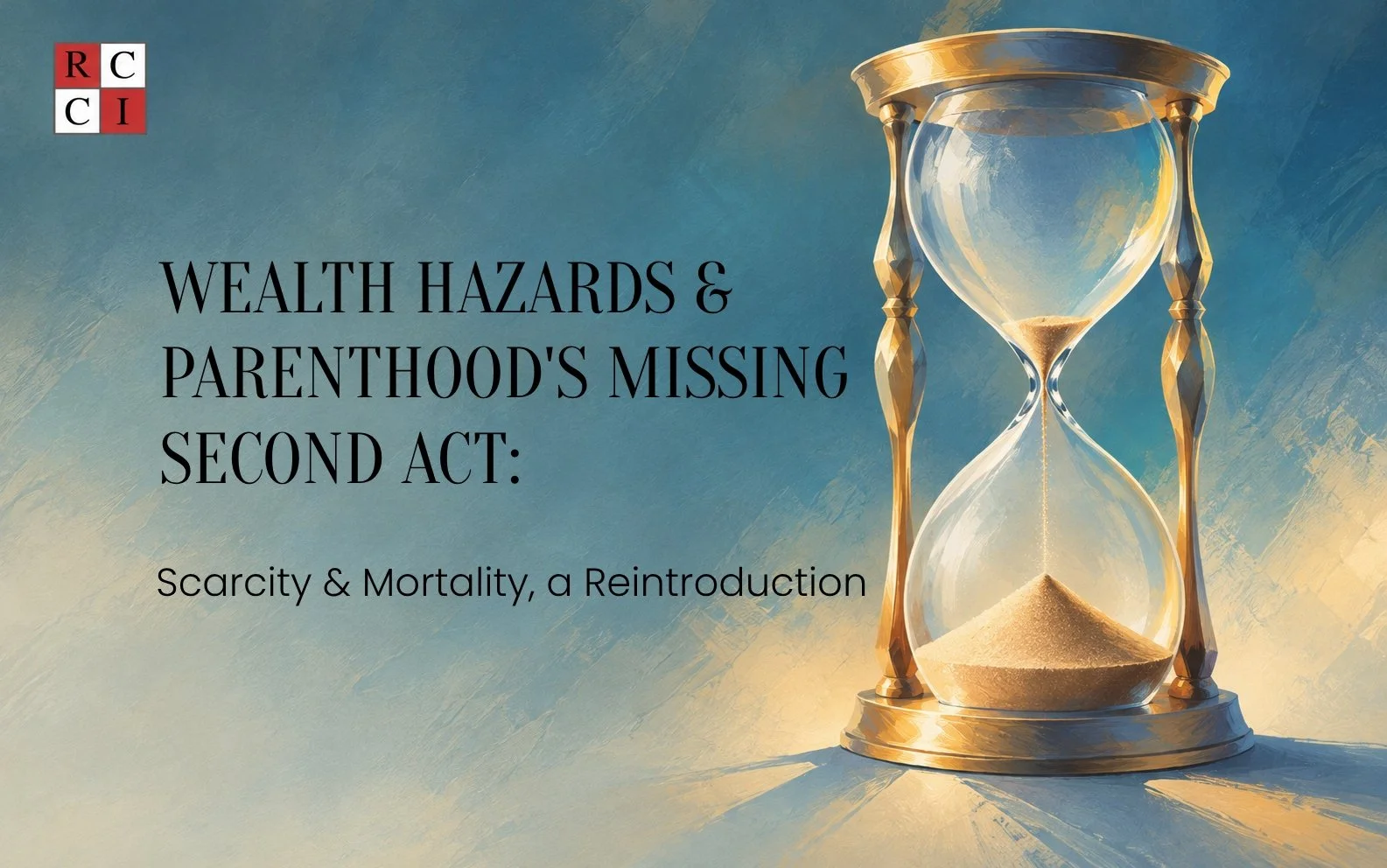
For parents, the Eriksonian stage of Generativity versus Stagnation covers their kids’ journey through multiple stages. Resolving this dilemma requires a lifestage of material and relational fruition. In this stage we start to build that which lasts beyond us. This relates to mortality. As children fledge and then as our careers taper, Generativity versus Stagnation moves towards Integrity versus Despair. Now, to resolve the dilemma, we must come to terms with our mortality, what and who will carry on after we have gone, and we aspire to have conferred upon us by those to whom we belong the integrity of being an elder of value. There is not much space for this lifestage in the dominant culture. Most of what is projected in the media suggests a double-bind of “regression/elixirs versus senility/irrelevance.” Healthfulness and even vanity have their place, but there is a kind of avoidance of Life and lack of purpose that belies the dominant culture’s subtle Despair. Meanwhile, scarcity is engineered out of our lives, which blinds us to the ultimately scarcity of Time. Wealth, set in a culture of infinite diversions, defers this process until bodies or minds fail. People die unprepared, the surviving family is unprepared, avoidance is redoubled through diversion, grief is foregone or unresolved, no one knows what is missing.
Viktor Fankl would distill what he learned of happiness in Auschwitz in his book Man’s Search for Meaning (1959). Happiness is a by-product of meaning or purpose. Happiness, for its own sake, is a vapor. However, with purpose, humans can even suffer and experience happiness. I want to be careful with my words. Christopher Hitchens, I believe, would not have had the same criticism of Frankl that he had of Mother Teresa. Frankl did not fetishize suffering. But, rather, in a hell that killed through physical and psychological mechanisms, he recognized, in himself and in others, a process of meaning that could not be taken away, even from those who were killed. Meaning is different than power and fame in that those phenomena exactly remove people from true relationship. The settled adaptation to them is mistrust, fittingly, a corruption of Erkson’s first stage (2) (3). Meaning is relational, it brings us into and regulates human connection.
Our neurological relationship with food, today, provides a helpful parallel. Harvard evolutionary biologist Daniel E. Lieberman in his book, Fed Up (2026) (4), discusses the mismatch of modern society and the natural processes that created our bodies and neurology. Today, we live in a strange nano second of our evolution, where, for the first time we don’t need to know how to find food but which food to choose. Then, we ate to reproduce, and we ate almost anything we could get our hands on. Today we eat to be “healthy” or we are consumed by appetite itself. Moving from trees to savanah and becoming distance runners, as opposed to our far more sedentary ape cousins, we developed fatter brains (cholesterol) and fat stores other apes did not need. We, chubby apes, stored calories so that we could run down our prey and support bigger-brained, more vulnerable offspring. Whereas then, we were designed towards securing the scarce commodities of fat and sugar, now donuts can be delivered 24/7. Today, we live in an upside down world (5). We are predisposed to compulsion and addiction by dint of living in civilization; our drives were predicated on scarcities that no longer exist. This mis-match goes for all the rest of modern abundance, and so needs to inform parenting. In great material security, we cannot afford to only give to our children any more than we can afford to feed them without discretion. We have to discern in what quantity, when, and how giving makes sense. Scarcity was part of how Nature fashioned us. We have to construct functional scarcity to get children into true adulthood, so childhood can be left behind and the purpose of our relationships may transcend our individual life’s inevitable end.
REFERENCES
Steiner, C. (1974). Scripts People Live: Transactional Analysis of Life Scripts.
Ferns, B. [Barry’s Economics] (13 September, 2026). Diary of a CEO Responded to My Take-Down. I Wasn’t Ready for This [Video]. YouTube. https://www.youtube.com/watch?v=Dqh17U3tymU
Rockwell, D & Giles, D. (01 January, 2009) Being a Celebrity: A Phenomenology of Fame. Journal of Phenomenological Psychology.
Berdugo, S. [The New Scientist] (26 September, 2026) Your Body Was Built for a World That’s Gone/Daniel Lieberman [Video]. YouTube. https://www.youtube.com/watch?v=puRaNQpwW6U&t=2422s
Lieberman, D. (2026) Fed-Up: What Evolution Reveals About Health, Food, Diet, and Living Well.